
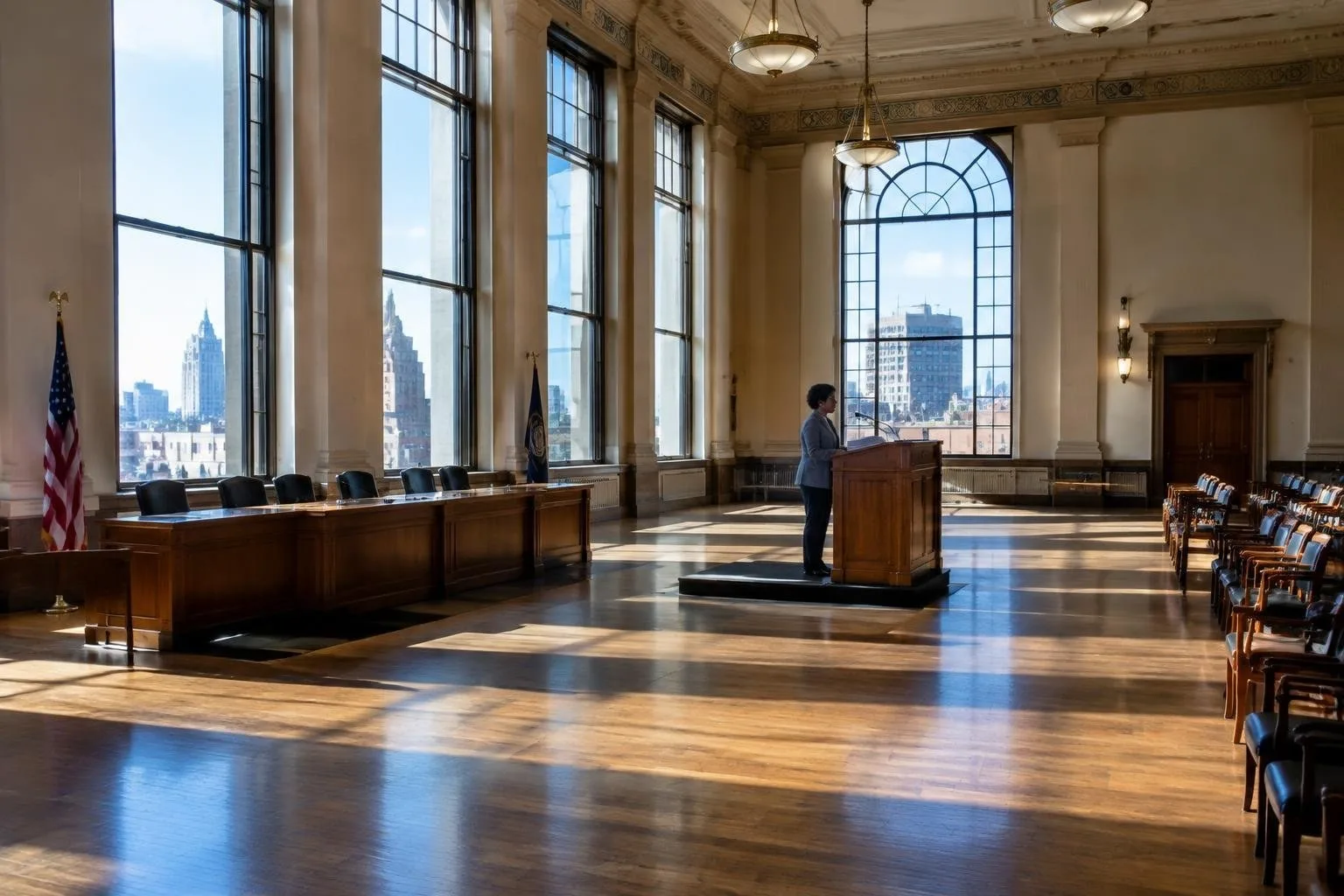
The recent town hall in Rochester brought together advocates, policymakers and residents to discuss a proposed $30 million Child and Family Well-Being Fund. Designed as a five-year pilot, the initiative would allocate resources across ten New York locales, five upstate cities and five neighborhoods in New York City, targeting families that experience both poverty and systemic neglect.
“This fund is really intended to repair issues and heal issues faced by children and families, because poverty is not the same as neglect,” explained Brandy Shaw, manager of advocacy and policy at HOPE585. Yomika Bennett, president and CEO of the Black Child Development Institute of New York, added, “The whole point is to, one, bring in community members to have an intentional process of what they want to be funded, and two, get the folks who everyone in the community knows are out there doing the work, but aren’t looking on the internet for the grant report of the day because they don’t have the time, resources, or reach to do that.”
The fund’s structure and geographic reach
The legislation envisions a five-year pilot program that would divide $30 million among ten communities: the upstate cities of Rochester, Buffalo, Binghamton, Schenectady and Syracuse, plus the Bronx, Brooklyn, and East Harlem neighborhoods. Shaw noted that these areas were chosen because of a historic pattern of disenfranchisement and disinvestment, citing the high volume of Child Protective Services calls in Rochester as a stark example.
Administration of the fund would rest with a dedicated director and a nine-member advisory board. Money would flow through a “backbone” nonprofit that partners with a mid-size anchor organization in each community. These anchors, selected for their local credibility, would employ an asset-based community development (ABCD) approach to identify priorities and vet grant applicants.
Asset-based community development and grassroots grantmaking
ABCD, as defined by the Schuyler Center for Analysis and Advocacy, flips the usual deficit-focused model on its head. Rather than cataloguing what a neighborhood lacks, the method asks residents what they can achieve with existing strengths and minimal external input. Bennett illustrated the concept with a personal anecdote: “Maybe the community knows Ms. Yomika runs a diaper bank. I’m not a 501(c)(3), but I do it alone. If CFWF passes, now I can get money to keep that bank running without spending time chasing grant paperwork.”
Grant awards would range from $20,000 to $150,000, with the expectation of recurring funding for trusted, resident-staffed organizations that demonstrate direct engagement with local families.
Data that underscores the need for reform
HOPE585’s recent report on Monroe County, co-written by Shaw, highlighted glaring gaps in the child-welfare system. Of the 6,434 reports of suspected child abuse or neglect filed in 2025, 75% were ultimately deemed unfounded, suggesting a pattern of over-reporting that can strain families. The same analysis revealed that Black children were 5.5 times more likely, and Hispanic children 3.5 times more likely, to enter foster care than their white peers.
In the ZIP codes 14621, 14608, 14611, 14605 and 14613, between 33% and 64% of children live below the federal poverty line. Shaw emphasized that “that poverty forces families to choose between the necessities they need, but cannot afford all of.” These statistics provide the factual backbone for the fund’s focus on both prevention and direct assistance.
Legislative journey and upcoming milestones
The legislation first appeared in the state Assembly in 2022, was referred to the Standing Committee on Children and Families, and then stalled. Subsequent introductions in 2023 and 2025 met similar fates, though the state Senate did propose its own version last year. The bill is slated for another appearance in the 2027 legislative session.
Bennett urged local elected officials to become co-sponsors, stating, “I would love for all the 10 impacted communities’ representatives to be cosponsors of this bill because that is showing you are truly connected to your district.” Town-hall organizers plan additional meetings, including one recently held in Schenectady, to bolster public backing before the next session.